
East Carroll VINELink Release Coverage
Louisiana calls the service LAVINE or LAVNS, short for the Louisiana Automated Victim Notification System. The public person search is delivered through VINELink. The Louisiana Commission on Law Enforcement LAVINE program says it covers adult inmates in all parish jails and state prisons. DPS&C also says its locator includes people under probation or parole supervision. That statewide scope makes it relevant to East Carroll Detention Center and both Riverbend divisions, as well as a sentenced person in state custody.
Coverage is not the same as instant or complete history. DPS&C describes a daily update cycle. A recent Riverbend event may not appear at once, and a fully discharged record may not remain searchable forever. Community supervision means the person is outside physical prison custody but is still under probation or parole. It does not mean the sentence has fully ended.
LAVNS does not cover a person held solely by the Federal Bureau of Prisons or ICE. A transfer from East Carroll Parish to a federal or immigration authority ends the local custody segment without proving release to the community. Use the BOP locator, ICE's current-detainee locator, the court record, or the receiving agency for that separate segment.
Search East Carroll VINELink Records
Start at the Louisiana VINELink person search. The task is to identify one matching record, not to browse a general list of East Carroll Parish releases. Exact names and agency details reduce false matches. When an ID or case number is known, it can be more useful than a common surname.
- Open the person search and choose Louisiana if the state is not already selected.
- Enter the exact first and last name, or use the ID or case-number option.
- Narrow by location when that field helps, but do not reject a match only because the person was transferred.
- Compare the available date of birth, identifier, agency, and location before opening the record.
- Read the current label as written. Separate incarceration, release, transfer, and community supervision.
- If the result is blank, broaden spelling and call the last known custodian or the DPS&C locator.
The official Louisiana-specific search form shows the current entry route.
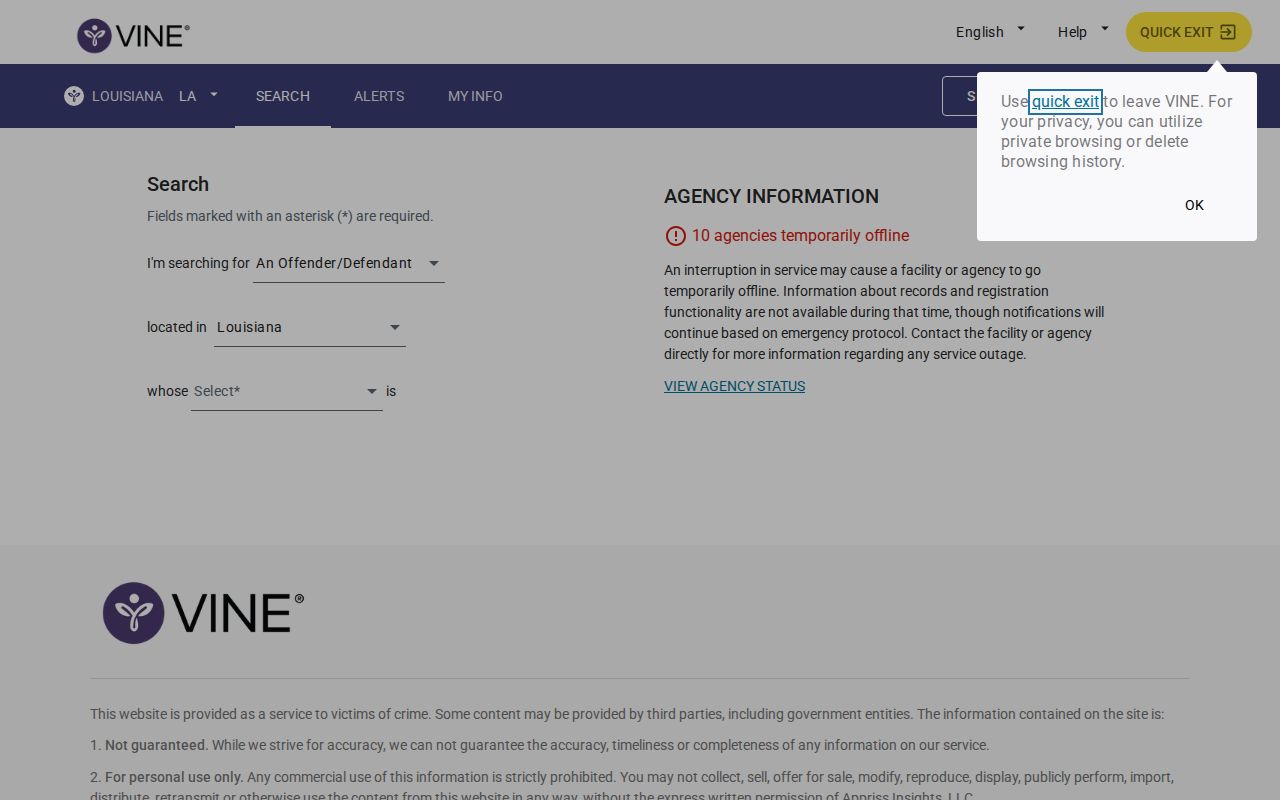
The form is an interface example. Fields and controls can change, so follow the live labels and confirm the matched agency before relying on the result.
For a fuller search across a local release row, the court case, and state custody, use the East Carroll Parish released-inmate lookup. VINELink is strongest when the person and last custody system are already known.
Read East Carroll Release Results
A VINELink result reports what the supplying agency has sent to the service. Treat it as status evidence, not a certified release certificate. Match the identity, record the agency and update details, and then ask whether the event describes release, transfer, imprisonment, or community supervision. These categories answer different questions.
| Field or label | What it can show |
|---|---|
| Name and identifier | Helps distinguish the intended person from a similar name |
| Agency or location | Identifies the custodian or supervising system reporting the record |
| Custody status | Indicates incarceration, reported release, or another displayed status |
| Community supervision | Supports that the person is outside physical prison custody but on probation or parole |
| Event or update information | Shows the reported change and timing available in the live interface |
A “released” result is evidence that the supplying agency reported a custody change. It does not rule out another hold, a transfer to another sovereign, or later supervision. A transfer notice means custody changed hands. It does not mean return to the community. If the system shows community supervision, use the DPS&C locator to find the assigned probation and parole district.
Do not assume the web record always displays a projected date. DPS&C's documented official route for that information is its phone locator at 225-383-4580, when a date has been calculated. The East Carroll Parish projected-release page separates that estimate from the actual exit event.
Note: Save the status and event details, then confirm the actual release with the agency that supplied the East Carroll custody record.
Set East Carroll Release Notifications
Registration begins from the exact matched record. Select the notification control and choose only a channel offered by the current interface. The official Louisiana sources reviewed do not establish that every registration uses the same phone, text, email, or account steps. They also do not establish a universal PIN requirement. Follow the live prompts rather than an old workflow found elsewhere.
- Open the record whose identifiers and reporting agency match the intended person.
- Select the notification or registration option shown on that record.
- Choose an offered contact channel and enter the requested destination accurately.
- Complete any account, channel, or confirmation step presented by the live service.
- If the telephone workflow asks for a PIN, choose a memorable number and keep it private.
- Save the confirmation and update contact details if they later change.
An alert is a prompt to verify, not the full record. A release alert may arrive after an agency reports the event. A transfer alert should be followed to the receiving custodian. For East Carroll Parish detention, call the Sheriff or Riverbend. For state imprisonment, use DPS&C and the relevant records or supervision office.
Two Louisiana Release Notice Layers
Louisiana has a distinctive second notice layer for eligible recipients in state-prison cases. LAVNS or VINELink registration is separate from registration with DPS&C Crime Victim Services or Victim Outreach. DPS&C expressly warns that a local LAVNS registration is not the same as its program for projected-release, actual-release, and other statutory state-prison notices.
The difference matters when an East Carroll Parish person moves from local detention into a DPS&C sentence. VINELink remains the broad locator and custody-change alert tool. The state Victim Outreach route serves eligible recipients seeking the separate notices described in the Louisiana Victim/Survivor Guidebook. One registration should never be described as automatically completing the other.
The DPS&C Victim Services page sets out the distinction between LAVNS and the separate state notice route.
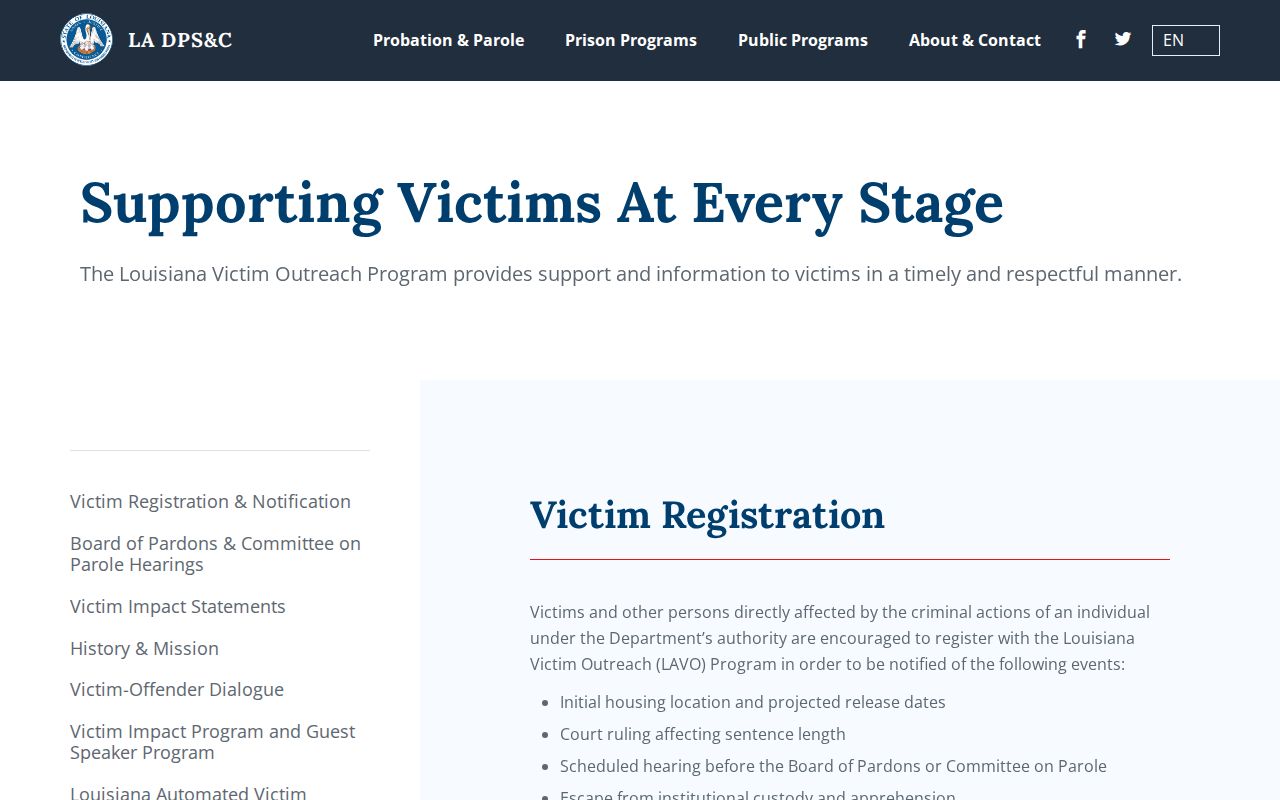
The state page confirms why a VINELink alert registration should not be presented as a substitute for every eligible state-prison notification program.
Confirm East Carroll Release Alerts
Choose the confirming office by custody type. For East Carroll Detention Center or Riverbend, ask the Sheriff or facility for the actual release or transfer date, time, and destination. Read the local roster's “Released” and “Transferred To” fields together. A destination of HOME supports community release. Another jail or agency supports transfer.
For a state prisoner, call the DPS&C locator and use the state records or assigned supervision route as needed. A court minute or parole result can explain legal authority, but it may precede physical exit. For a federal person, use the BOP system. For current immigration detention, use ICE's locator and direct agency confirmation. VINELink is not designed to resolve those federal records.
A complete East Carroll Parish verification normally combines the alert or status with one agency record. That extra source resolves the common gaps: update lag, another hold, a receiving institution, or supervision after release. It also distinguishes a lawful release from an escape or an unauthorized absence, neither of which is a release record.
Note: Read each custody-change alert literally; release, transfer, and community supervision are related events, but they are not interchangeable.
East Carroll Alerts by Custody Type
A local detention alert should be checked against the East Carroll Parish Sheriff's mixed-status roster and the facility record. The roster displays identity fields, a release date, and a transfer destination, but it omits exact release time, charge, bond, case number, reason, and photograph. If an alert says release while the row names another institution, ask whether the event was a transfer. If the destination is HOME, the two records more strongly support return to the community.
A state-prison alert requires a different follow-up. DPS&C can confirm the current facility, projected date when calculated, or assigned supervision district through its locator. A Committee docket or result can explain parole authority, yet a grant may precede physical release. A person listed under community supervision has left prison custody but has not necessarily completed the sentence. Tallulah Probation and Parole serves East Carroll Parish only when the state assignment points there.
Federal and immigration alerts remain outside LAVNS. The BOP locator can report a past federal release date and a location of RELEASED for many sentenced federal cases after 1982. ICE's locator addresses current immigration detention and is not a release archive. A person may pass from Riverbend to either system. Record each handoff so a local custody change is not mistaken for the end of all confinement.
The durable East Carroll court record provides another layer. A bond order, dismissal, sentence, probation order, or later minute may explain why release was authorized. It may not show the time the custodian executed that action. Pair the legal record with the facility event and use VINELink for the reported status or notification function it was built to provide.
East Carroll Registry Is Different
The East Carroll Sheriff links an agency-specific OffenderWatch registry, and Louisiana State Police operates the statewide registry hub. Those systems cover only people with a legal duty to register. They are not general lists of released inmates and should not be used to fill a blank VINELink result.
A current registry entry may corroborate specialized community information for a person subject to that law. It does not prove the Riverbend release date, release reason, or end of supervision. Confirm those facts with the release record, court file, DPS&C, or assigned supervision office. Keeping the registry separate protects the accuracy of both searches.